There’s an AI crisis. But it isn’t "AI slop."
If you haven't seen it yet, LinkedIn recently added a new reason for reporting a post:
“Seems like AI slop.”
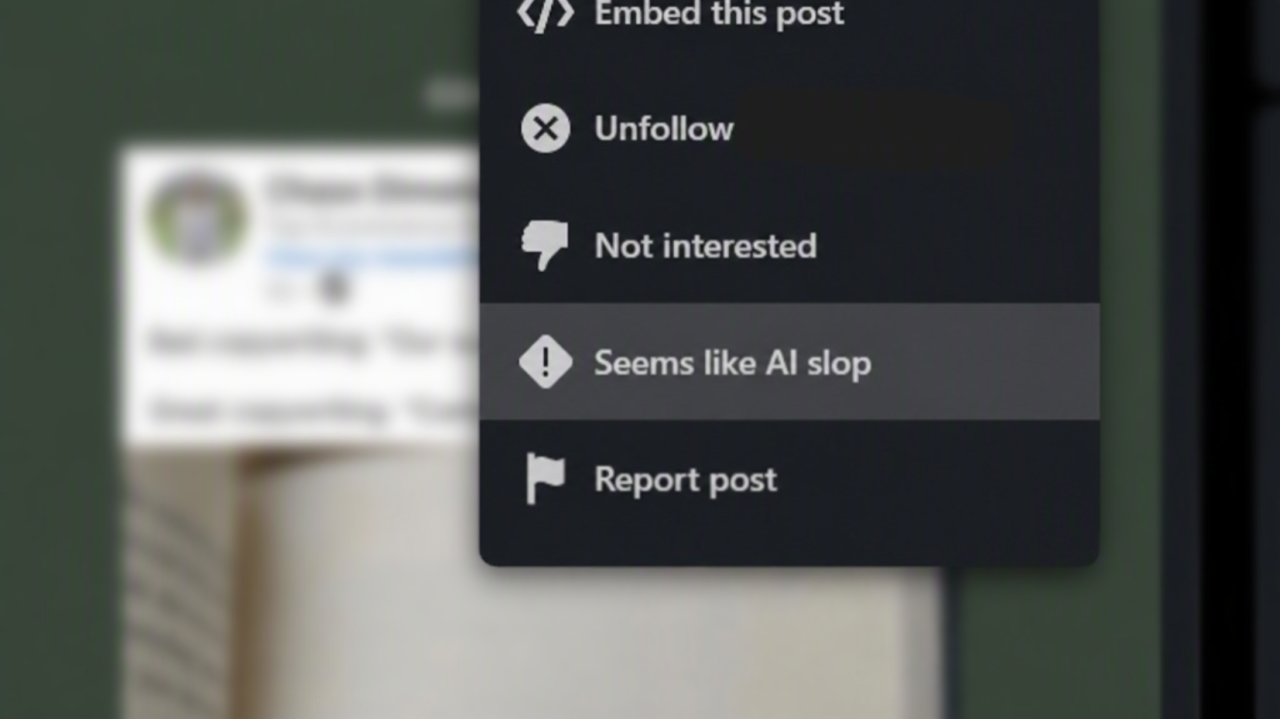
"Seems like AI slop" was a new feature added to Linkedin in the middle of 2026. But it's just the tip of the iceberg.
That says something about how quickly our relationship with AI has changed.
When ChatGPT first launched, it felt like we were getting everything science fiction had promised. Suddenly, you could have your own version of Jarvis. You could write faster, research faster and get an artificial second opinion on almost anything.
I used it frequently. I wrote posts and video scripts with it. I had it review my website and my clients’ websites.
Now, the same platform that was flooded with posts about everything AI could do for us is giving people a button to say: “Nah. AI slop. Don’t want to see it.”
AI slop is a problem.
But it isn’t the AI problem I’ve been researching.
Burnout is.
Just take a look at a couple of these headlines:
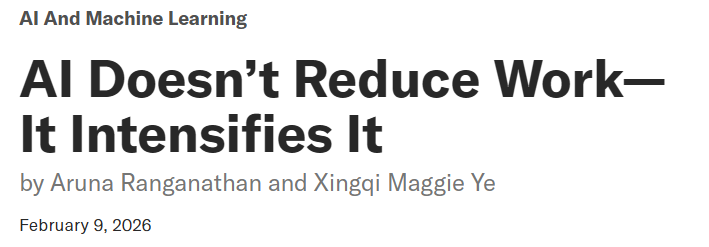
Source: Harvard Business Review
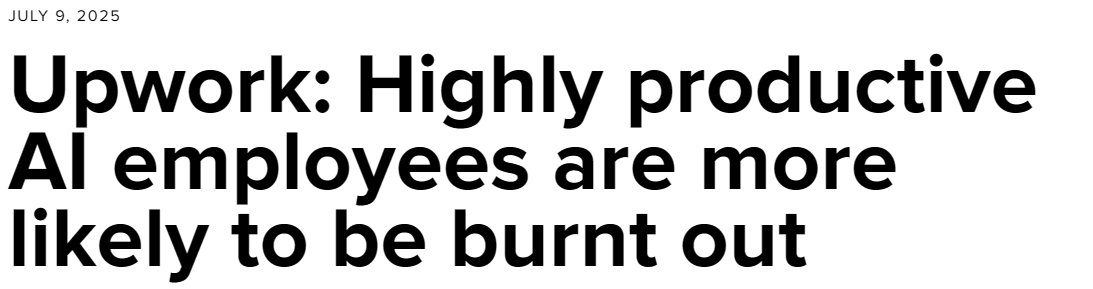
Source: Upwork
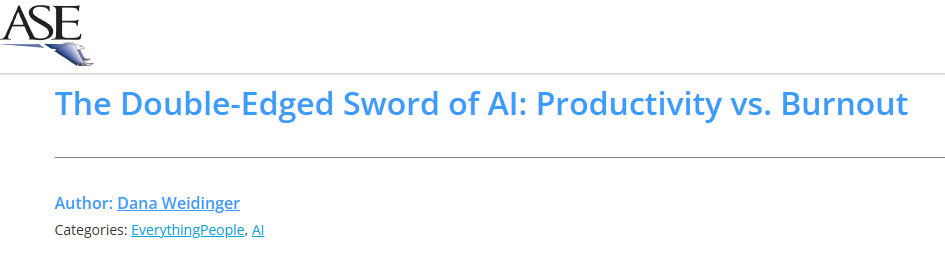
Source: ASE
Research is beginning to connect AI-enabled productivity with intensified workloads and burnout. Harvard Business Review has reported that AI can increase the pace and volume of work rather than reduce it. Research covered by Upwork and the American Society of Employers has pointed to the same tension: the more capacity AI creates, the more organizations and workers expect themselves to produce.
So what is the connection between AI and burnout?
The premise for this article was that I kept seeing posts from colleagues describing the same strange experience: AI was making them more productive, but it wasn’t making their lives easier.
So I started interviewing people in my network about it to get their takes.
Faster work becomes more work.
My first interview was with Lee McEnany Caraher, founder of global PR firm Double Forte.
When Lee started her career, fax machines and FedEx were the cutting edge of speed. Something that once gave you a week to consider could suddenly demand an answer by the next day.
And Lee’s point was that the pattern hasn’t really changed.
Lee Caraher
"“I think productivity tools have taken consideration and judgment out of the equation and increased, not decreased work,” she told me. “If your work is speeding up, you’re actually creating more. You’re not creating less."
Technological leaps don’t necessarily give us more free time. They raise the expectation for how much we can get done.
Of course, AI isn’t the fax machine. It is a productivity leap several orders of magnitude larger.
Which means the pressure it creates can be larger, too.
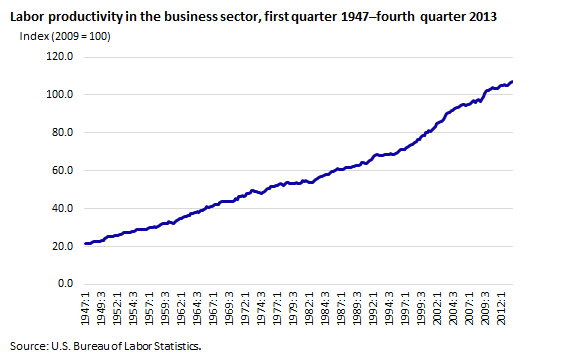
US worker productivity chart, ending in 2013. That's roughly 9 years before AI was even a thing. Surely there's a cap... somewhere?
AI can create margin. But it can’t decide what to do with it.
My next interview was with Chili Piper founder Alina Vandenberghe 🌶️, whose LinkedIn post helped inspire this investigation.
Alina is an avid AI user. She has watched people use Claude to build businesses and create new streams of income, and she’s excited about what they can now accomplish.
Alina Vanderberghe
She also sees the genuine promise of the technology.
That is what we were promised: AI would take away the work we don’t enjoy and give us more time for creativity. That's honestly how I've used it the most and what excites me about it.
But Alina has also watched people work hard to keep AI from producing generic results.
AI can create the margin. It can’t decide what deserves that margin, supply your point of view or prevent you from immediately filling the space with more work.
Those decisions still belong to us.
There is always one more thing you could do.
LinkedIn ghostwriter Jillian Whitlow noticed the same problem from a different angle.
Even if AI technically allows people to work fewer hours, she pointed out, we tend to cram more tasks into those hours.
She experienced it herself after an AI app builder offered women 24 hours of free access. Jillian came up with an idea and started experimenting while her kids were napping.
That night, with the free access about to expire, she stayed up late trying to finish what she had started.
The revealing part?
It was something she admitted she didn’t actually need.
That’s the trap.
AI makes starting another project so cheap and easy that there is always one more thing you could be doing.
And when we’re shipping more things faster, Jillian questions how much meaningful human oversight those things receive.
Without that judgment, the time AI supposedly saves can easily be consumed by correcting average output, catching avoidable mistakes or cleaning up something that never needed to be created in the first place.
We feel responsible for doing "everything".
My conversation with website copywriter Elle Rosselli surfaced another consequence: AI doesn’t merely help us do our existing jobs faster. It acts as a type of scope creep to what we believe our jobs should include.
You’ve probably seen the mentality on LinkedIn:
“Leverage AI, or get left behind.”
Copywriters now feel pressure to add SEO, design, development and automation. Work that previously required a team can theoretically be completed by one person with a collection of AI tools. Many people start wondering whether they should become an agency of one.
Elle Rossell
The question isn’t simply what AI can do.
As Elle put it:
Without a clear answer, every newly accessible capability can start to feel like another responsibility.
And the time we save rarely becomes actual time off.
Productivity vs human-determined margin
While I was researching this article I came across a post by Tyler Pigott, VP at StoryBrand. That's when I realized that this problem goes much deeper than AI. So we got a on a call and talked about it.
AI is simply the most powerful productivity tool we’ve created so far, and it is exposing a pattern that has been there all along.
Tyler pointed out that with AI, it can feel like the only limits are: What can I imagine? What do I know how to ask?
At first, that feels like freedom.
But it can quickly become overwhelming.
He makes the point that technology used to have physical boundaries. You left your computer at work because it was a gigantic machine that stayed on your desk.
Now, we carry computers in our pockets that are exponentially more powerful—and they talk back to us.
Tyler Pigott
When you have that kind of capability at your fingertips, Tyler said, we’re eventually forced to ask:
That is the question at the center of all of this.
Tyler described the choice this way:
AI creates capacity. But instead of using that capacity to do more of what we love—or simply to do less—we often fill it with more tasks, more projects and more pressure.
AI really can give us time back.
The problem is that neither our workplaces nor our own ambitions are very good at letting us keep it.
AI burnout is a human problem, not a technology problem.
I’ve seen this pattern in my own life.
In 2016, I got divorced and became a single dad of three kids. Because I had my kids half the time, I suddenly had more room in my schedule.
And without consciously deciding to, I filled every single inch of it.
I went out to eat with friends weekly. I ramped up building my freelance graphic design business on the side of my W2 job. I hosted game night every other Friday, played soccer twice a week and resurrected an expensive paintball hobby from high school.
Then, in the spring of 2018, I started dating the woman who would become my wife.
A few months in, she told me she didn’t feel like a priority.
She was right.
I cared deeply about her, but my calendar didn’t reflect it. I had treated our relationship like one more thing to squeeze into space I had already filled.
So I made room.
Some friendships and hobbies had to take a back seat. That was painful, but it gave our relationship the space it needed. The following spring, we got engaged. That fall, we got married.
Now, filling our time requires a conversation and a decision. We add things when we have the capacity. We remove them when life gets full.
I’m trying to apply the same rule to AI and my business at Dialog.
I’m honoring the margin.
That means I don’t use AI simply because I can.
We use it where it genuinely makes the work better or faster. And we leave humans in charge of the things humans are better at: judgment, taste, relationships and original thinking.
My editor, Jordan, can use AI when it helps him. Often, he doesn’t, because our experiments found that AI was bad at identifying the moments from a conversation that were actually meaningful.
I don’t use AI to write my content anymore. Editing? Sure. And I still get my content ideas by talking to actual people: clients, prospects, partners, my team and other founders.
That is also why I’ve doubled down on video-first content.
Instead of asking AI what I should think, I start with a conversation. The ideas come from humans. Just like this article. Technology just helps us capture, edit and distribute them.
The goal isn’t to squeeze 20% more work into the 20% of my time AI just saved.
The goal is to keep the 20%.
To honor the margin.
And to make sure the work serves my life. Not the other way around.
If you want to create content that honors your margin and builds trust faster with buyers, I offer a free 30-minute video session. We’ll have an easy conversation about what you do and turn it into one short professionally edited video, with no commitment required: https://calendly.com/dialogdesignco/free-video
References

About Justin
Justin is a marketing nerd. His gateway drug was in middle school when he and his buddies would make up brand names and draw logos for fun. He graduated with a B.A. in Graphic Design from UW Eau Claire. He then cut his teeth leading the marketing for a $4 million non-profit, moving them into the digital age with new channels and systems. He joined a $60M healthcare manufacturer as marketing team of 1, helping grow them to $90M in three years. Justin became a full-time marketing entrepreneur in 2018. He now enables founders to grow their pipeline and thought leadership through social media videos. Follow him on Linkedin here.